Open the pocketoption terminal on a Saturday and you will still see dozens of assets with “OTC” after their names — EUR/USD OTC, Apple OTC, S&P 500 OTC. Many beginners wonder what these are, why they move when the real market is closed, and whether they are safe to trade. This guide explains how OTC works on Pocket Option, the current asset schedule, payout patterns, the specific risks and a sensible approach for weekend trading.
What “OTC” means on Pocket Option
OTC stands for over-the-counter. In the classic sense it means trading directly between two parties rather than through an exchange. On Pocket Option the term describes assets whose price feed is provided by the platform (its liquidity provider) rather than taken from an exchange or interbank market. That is why OTC assets can be quoted around the clock: the platform continues to generate a price stream even when the underlying market is closed.
| Regular assets | OTC assets | |
|---|---|---|
| Price source | Interbank / exchange quotes | Platform-generated quotes based on the underlying |
| Trading hours | Market hours only (forex Mon–Fri, stocks exchange hours) | 24/7 including weekends and holidays |
| Reaction to news | Immediate, follows real market | Indirect; no live market to react to at weekends |
| Comparable with external charts | Yes | No — chart differs from TradingView or other brokers |
| Typical payouts | 50–92% depending on session | Often 85–92% at weekends |
OTC asset schedule (2026)
Pocket Option publishes availability tables for its OTC assets. The general pattern is simple: OTC versions of currency pairs, stocks, indices and commodities are available 24/7, while the regular versions follow their market hours.
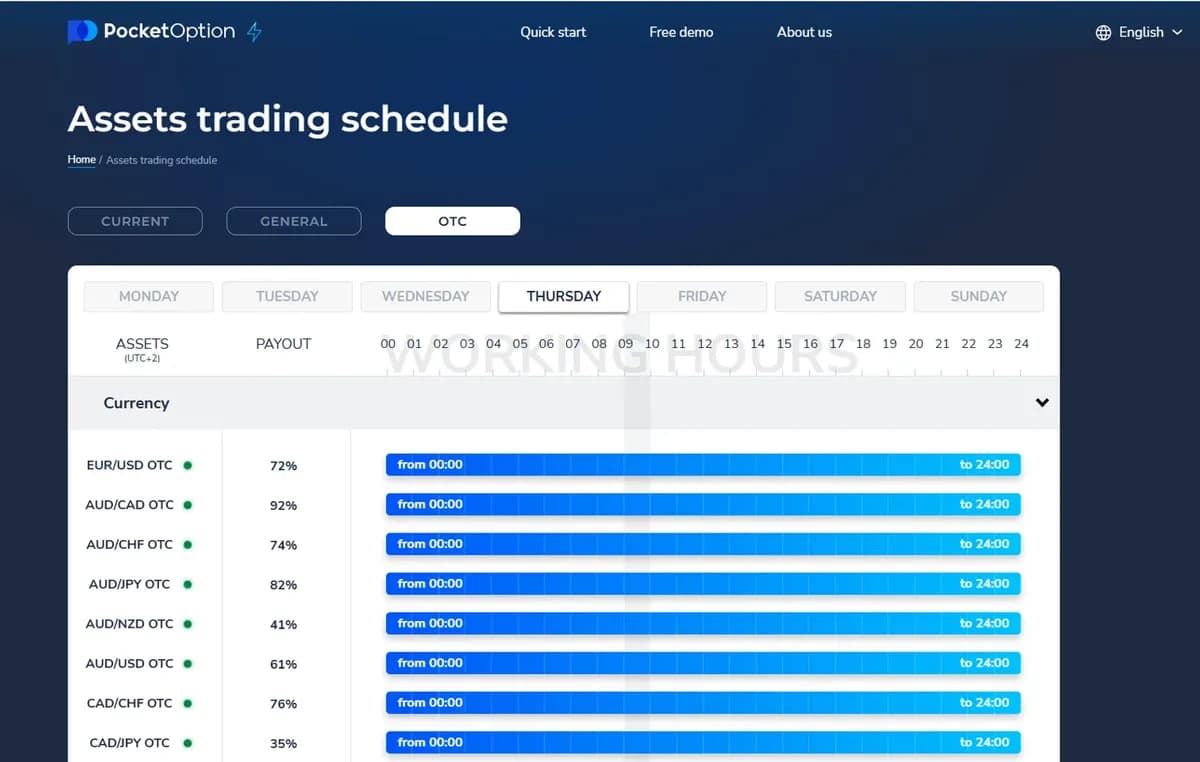
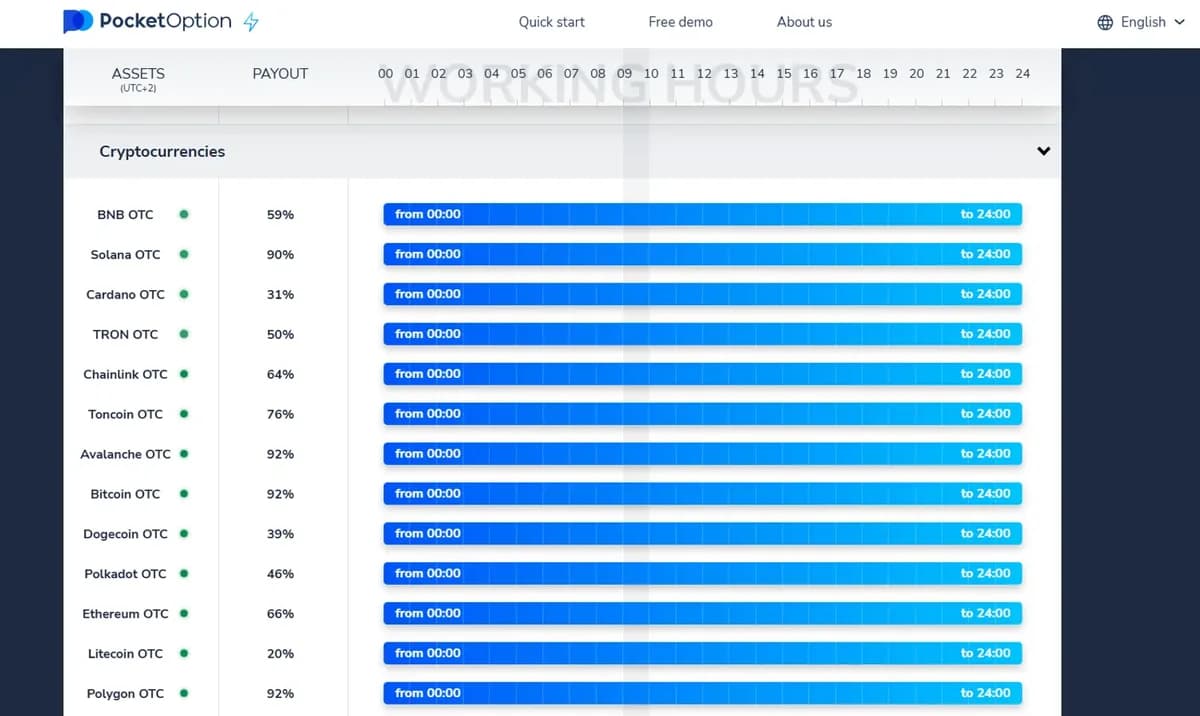
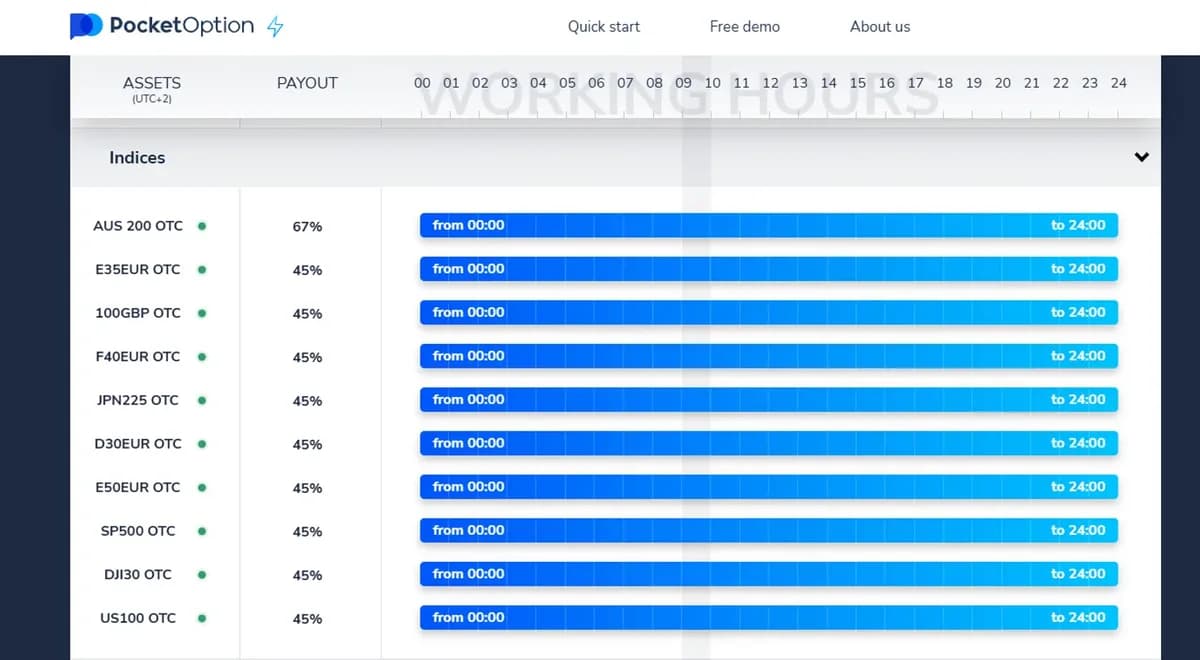
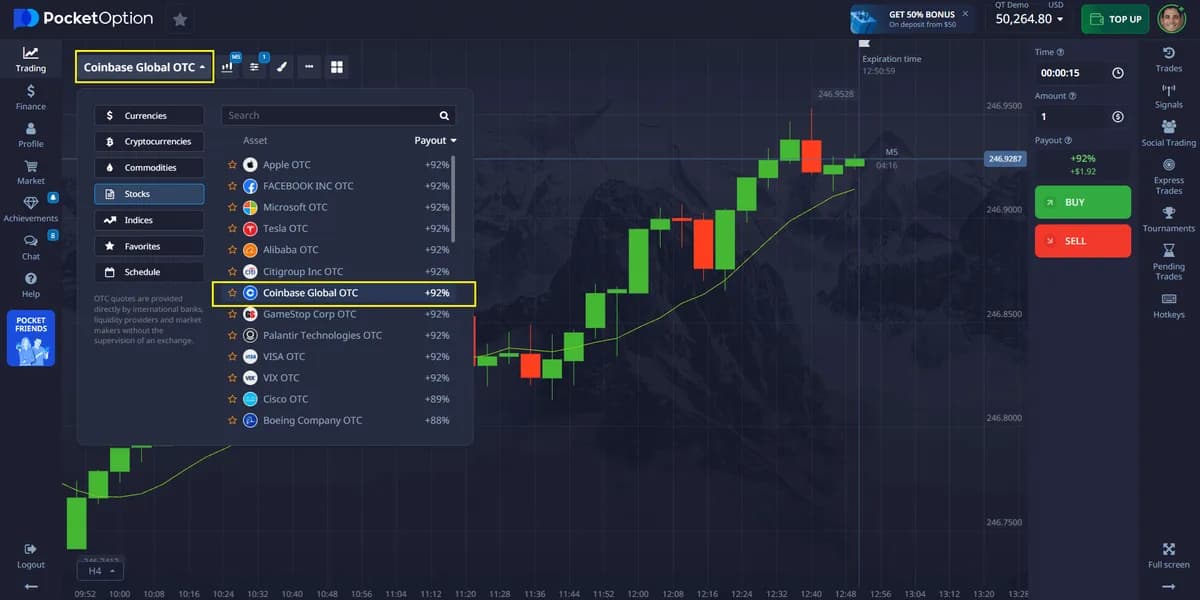
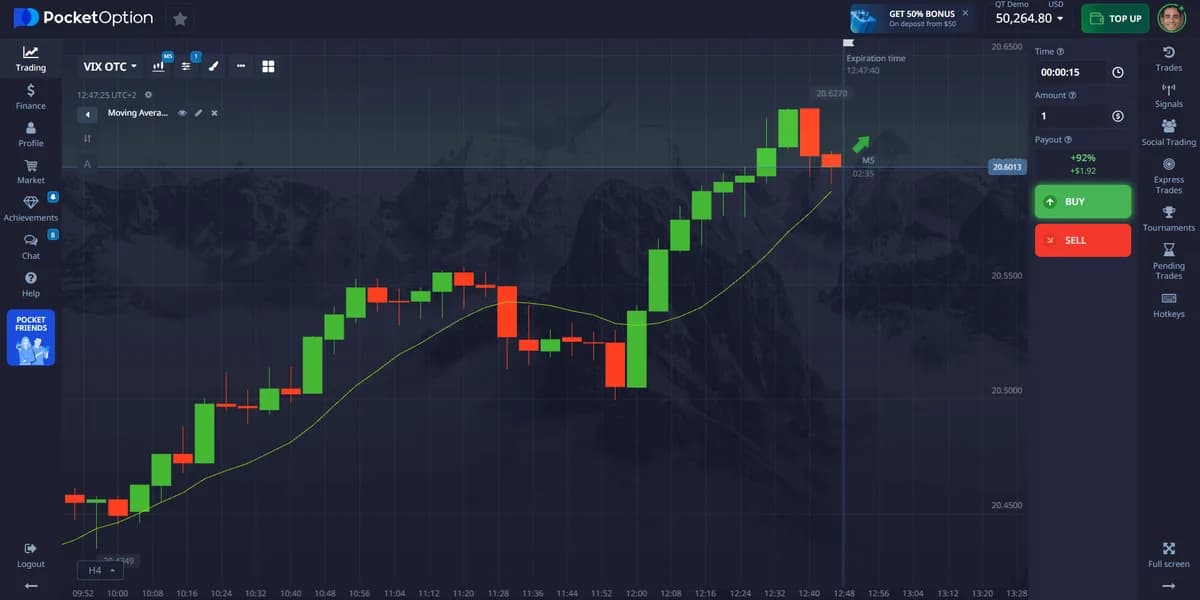
The exact list changes as the platform adds assets — recent additions included more US stocks and volatility indices such as VIX OTC. Check the asset list in the terminal for the current selection; the platform may also pause an OTC asset temporarily.
Why OTC payouts are often higher
At weekends OTC pairs are the most traded assets on the platform, and Pocket Option typically sets payouts of 85–92% on the popular OTC currency pairs. During the week, when regular assets are active, OTC versions may show similar or slightly lower payouts than their regular counterparts. As always, the percentage next to the asset in the terminal is the only figure that matters — it changes throughout the day.
How to trade OTC assets on Pocket Option
- 1Open the asset list in the terminal and type “OTC” in the search field to see all OTC instruments with their payouts.
- 2Pick 2–3 liquid OTC pairs with payouts above your minimum (e.g. EUR/USD OTC, GBP/USD OTC, AUD/CAD OTC).
- 3Use the 1-minute or 5-minute chart and add two or three indicators you already know (for example EMA 20/50, RSI 14, Bollinger Bands).
- 4Trade with the visible trend or at clear range boundaries; avoid trading in the first minutes after the weekend session opens, when the range is still forming.
- 5Use expiries of 1–5 minutes rather than 5–30 seconds; very short expiries on OTC are closer to guessing.
- 6Set a daily limit — for instance 3 consecutive losses or 5% of the balance — and stop when you reach it.
Risks specific to OTC trading
- Quote generation — prices are platform-generated; treat sudden spikes as part of the market and never “chase” them.
- No news edge — economic calendars and external analysis do not apply at weekends.
- Over-trading — 24/7 availability tempts traders to trade when tired or bored; set session times.
- Different behaviour — an indicator setting that works on regular EUR/USD may not work on EUR/USD OTC; keep separate journal statistics.
- Same payout mathematics — a 90% payout still means you need a win rate above 52.6% just to break even.
Pros and cons of OTC on Pocket Option
| Pros | Cons |
|---|---|
| Trade any day, any hour — ideal for weekend-only traders | Quotes cannot be verified externally |
| High payouts (often 85–92%) on popular OTC pairs at weekends | External news and fundamentals do not apply |
| Access to stocks and indices outside exchange hours | Behaviour differs from regular assets — strategies need re-testing |
| Wide range: forex, stocks, indices, commodities, crypto | Easy to over-trade because the market never closes |
Try OTC assets risk-free this weekend: open a demo account, search “OTC” in the asset list and test a simple range strategy before depositing from $5.
Open a free demo account